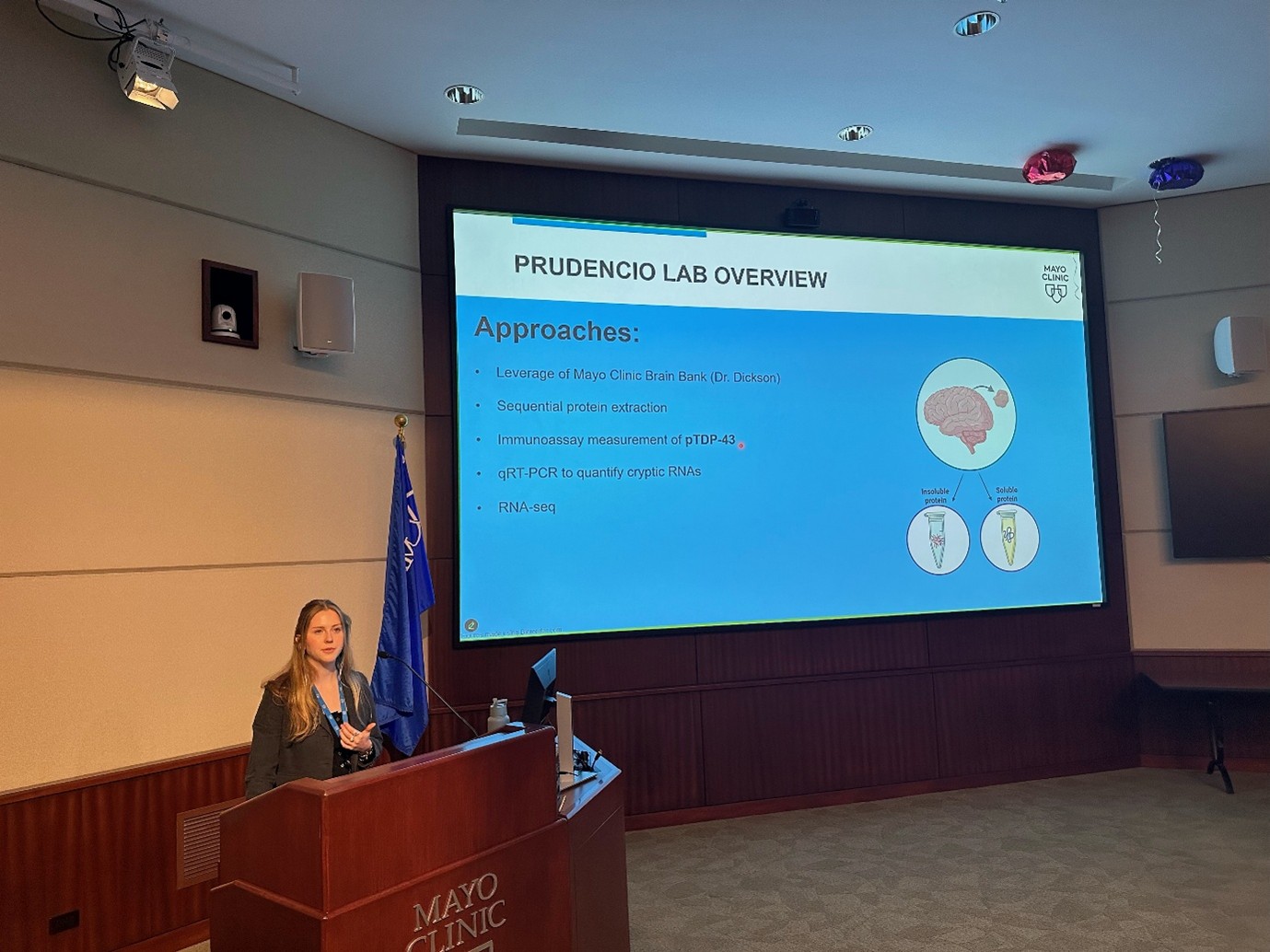
Sophie Ball, BSc Biochemistry Industrial Placement
Where did you do your placement year & what was your job role?
I completed my placement year at the Mayo Clinic in Florida, where I worked as a Neuroscience Research Intern. I was part of Mercedes Prudencio’s laboratory, which focuses on identifying biomarkers and therapeutic targets in neurodegenerative diseases such as ALS and FTD, with particular emphasis on RNA metabolism and TDP-43 dysfunction.
Could you describe a typical day on your placement?
A typical day on my placement was predominantly lab-based, often beginning with a group lab meeting where we shared ideas, discussed ongoing findings, and occasionally presented journal clubs. Much of my work involved human post-mortem brain tissue, with responsibilities focused on generating experimental data, including protein and RNA quantification and the assessment of pathological markers such as TDP-43.
Our lab worked closely with the Mayo Clinic brain bank, which meant that I also gained experience in administrative and data-management tasks, such as keeping track of the 16,000+ biospecimen samples using Excel. In addition to this, I carried out computer-based work including developing experimental protocols based on existing literature and reviewing research to prepare presentations for lab meetings, which helped inform future project directions.
What were your key responsibilities? How did these develop as your placement progressed?
One of my key responsibilities was extracting protein from human brain tissue, a technique that only a small number of individuals in the lab were trained to perform. As a result, I became a key resource for processing large sample batches, often handling hundreds of samples per request.
As the placement progressed, my responsibilities expanded to include the independent development of a research project that diverged slightly from the lab’s core focus. Following a grant award to investigate Parkinson’s disease, my principal investigator required enhanced capabilities to quantify α-synuclein in diseased brain tissue. I contributed to this effort by developing and optimising an assay to measure levels of pathological α-synuclein in human brain samples, thereby strengthening the lab’s analytical capacity in this area.
What was the most challenging part of your placement?
The most challenging aspect of my placement was learning to manage the unpredictability of experimental research. Experiments did not always go as planned, and it was initially easy to take setbacks personally given the significant time and effort invested. Over time, I learned to view these challenges as part of the scientific process. Additionally, the nature of the work occasionally required unpredictable hours, which could make some days particularly demanding; however, this was uncommon and contributed to my ability to adapt to a professional research environment.
What advice would you offer to other students thinking aboput doing a year in industry?
? My advice to students considering a year in industry would be to approach the placement with an open mind and without expectations. The experience can be challenging and unfamiliar, but this is what makes it so valuable and exciting. I would encourage students to ask questions frequently and take full advantage of learning opportunities, as the placement is not only about contributing to an organisation but also about developing skills and knowledge that will enhance their degree and future career prospects.
What opportunities has your industrial placement opened up to you?
My industrial placement opened up several valuable opportunities, including the chance to present my research at an international Alzheimer’s conference. This experience allowed me to engage in discussions with a wide range of talented scientists, broadening my scientific perspective. In addition, the placement helped me gain a clearer understanding of the diverse graduate career pathways available to me, both within and beyond laboratory-based research.
What was the highlight of your placement?
The highlight of my placement was delivering my final project presentation to the research department. I invested significant time and effort into preparing the presentation, and I felt that I delivered it with confidence and clarity, which was reinforced by the positive feedback I received from colleagues. This experience was particularly rewarding as it allowed me to reflect on how much I had developed over the course of the placement, demonstrating my ability to work effectively under pressure and strengthening my confidence in public speaking.